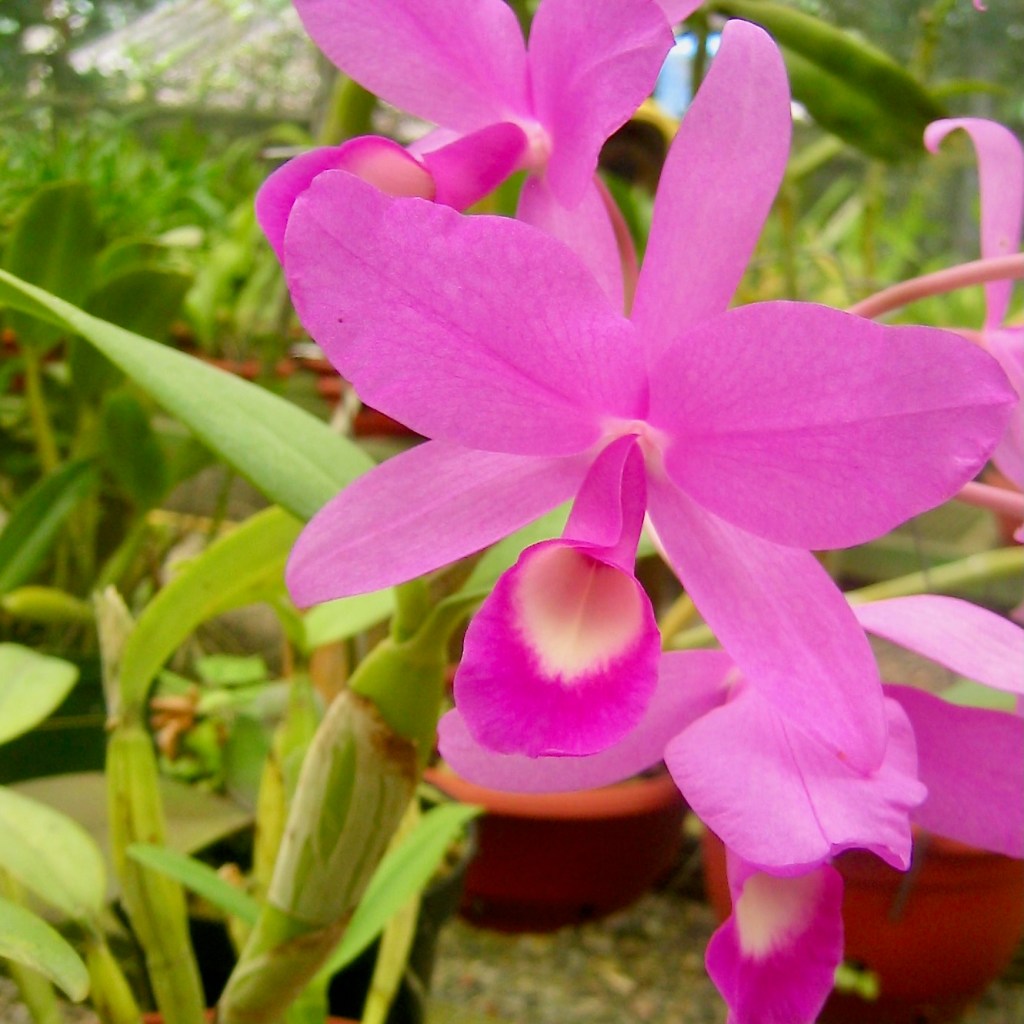
It’s hard to describe the moment when a flower opens your mind. But I remember this one vividly. After graduating from the University of Maryland with a degree in Natural Resource Sciences in 2005, I found myself pulled toward something I couldn’t yet name. I had learned so much about systems, genetics, and sustainability—but I hadn’t yet seen enough of the real world. So I bought a one-way ticket to Costa Rica and signed up as a volunteer at the Jardín Botánico Lancaster near Cartago.
There, nestled in the cool, misty hills, I worked with their orchid conservation team carefully tending to these plants that, when placed in the right environment, thrive in ways that seem almost otherworldly. Each orchid had its own rhythm, color, and story. What fascinated me most was how each species had evolved alongside a specific pollinator, some attracting hummingbirds, others drawing in bees or moths, each relationship finely tuned by nature. It was mesmerizing. But more than that, it was grounding.
Even though I spent my weekdays volunteering in the garden, on weekends I’d head out on excursions into the surrounding forest. The journeys themselves were layered: I’d walk from village roads through coffee plantations, then slowly cross into zones where wild biodiversity still thrived. Along the way, I noticed how everything was connected. The coffee plants relied on shade—often provided by native trees that also supported birds, insects, and forest life. What struck me was the continuity: people cultivating coffee, trees offering shade, and the forest not far beyond.
It was a pattern I began to see everywhere—nature working through relationship. And it reminded me of something I’d first seen in the garden. I was already aware of the stories about agriculture replacing nature, of deforestation and biodiversity loss. Those are real and important, and I don’t ignore them. But what I saw on those weekends was potential. In many parts of the world, the land that touches the forest is agriculture. Farms are the transition zone. And that means they’re also the opportunity zone. Instead of framing agriculture only as a threat to nature, what if we saw it as a partner to it? A working landscape where people steward the boundary between cultivation and conservation. That idea stuck with me. It was the first time I saw that agriculture could be more than production. It could be a bridge.
What stayed with me most was this: in the natural world, nothing thrives in isolation. Orchids flourish because of the pollinators they have evolved alongside. Forests are strongest when the surrounding landscapes are thoughtfully managed to support them. Whether it’s a bee drawn to a single bloom or a farm sitting at the edge of the wild, what matters is the relationship—the connection—and how each part contributes to the vitality of the whole. That perspective shifted how I began to think about people, teams, and agricultural systems. Agriculture is not a monolith. Behind every product or practice lies a mosaic of climate, culture, and human intention—and like any system that works well, it benefits from thoughtful design. Nature teaches us that thriving depends on right relationships, and design thinking reminds us to shape systems with that same care and awareness. Like pollinators and orchids or shade trees and coffee, the most enduring outcomes are built on interdependence that is understood, honored, and intentionally cultivated. That was the perspective I didn’t know I was looking for, but it changed the way I saw everything.
What This Taught Me
That time in Costa Rica taught me something I carry with me everywhere: thriving comes not from uniformity, but from connection. Whether among species, across sectors, or between people and plants, success grows when we design relationships that fit. In nature, fit determines survival—orchids flourish when matched with the right pollinators, just as crops thrive in climates suited to their needs. The same principle applies in professional life. People do their best work when they’re placed in the right environment, on the right team, doing the work that matters most. When individuals are encouraged to operate in their niche and bring forward their unique strengths, we build systems that function like ecosystems—alive, coordinated, and built to last. I hold onto that perspective as a vision for agriculture: not as a barrier between the city and the forest, but as the thread that weaves them together. When we recognize the specialized roles, environments, and expertise behind every commodity and choose to design for collaboration instead of control, we create something more enduring—something capable of supporting both people and the planet.
Let’s Keep the Conversation Going
What’s your niche—and what environment helps you thrive in it?
I’d love to hear from you. Join the conversation on LinkedIn.